|
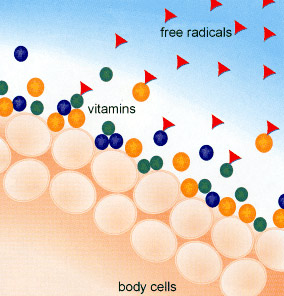
Normally, bonds don? split in a way that leaves a molecule with an odd, unpaired electron. But when weak bonds split, free radicals are formed. Free radicals are very unstable and react quickly with other compounds, trying to capture the needed electron to gain stability. Generally, free radicals attack the nearest stable molecule, "stealing" its electron. When the "attacked" molecule loses its electron, it becomes a free radical itself, beginning a chain reaction. Once the process is started, it can cascade, finally resulting in the disruption of a living cell.
Some free radicals arise normally during metabolism. Sometimes the body? immune system? cells purposefully create them to neutralize viruses and bacteria. However, environmental factors such as pollution, radiation, cigarette smoke and herbicides can also spawn free radicals.
Normally, the body can handle free radicals, but if antioxidants are unavailable, or if the free-radical production becomes excessive, damage can occur. Of particular importance is that free radical damage accumulates with age.
The vitamins C and E, are thought to protect the body against the destructive effects of free radicals. Antioxidants neutralize free radicals by donating one of their own electrons, ending the electron-"stealing" reaction. The antioxidant nutrients themselves don? become free radicals by donating an electron because they are stable in either form They act as scavengers, helping to prevent cell and tissue damage that could lead to cellular damage and disease.
Source: Health Check Systems
Image provided by: Body Building |