Adiscipline of biology, is the science of heredity and variation in living organisms. Knowledge of the inheritance of characteristics has been implicitly used since prehistoric times for improving crop plants and animals through selective breeding. However, the modern science of genetics, which seeks to understand the mechanisms of inheritance, only began with the work of Gregor Mendel in the mid-nineteenth century. Although he did not know the physical basis for heredity, Mendel observed that inheritance is fundamentally a discrete process where specific traits are inherited in an independent manner—these basic units of inheritance are now called genes.
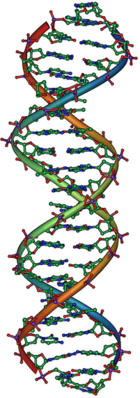
DNA, the molecular basis for inheritance. Each strand of DNA is a chain of nucleotides, matching each other in the center to form what look like rungs on a twisted ladder.
Genes correspond to regions within DNA, a molecule composed of a chain of four different types of nucleotides the sequence of these nucleotides is the genetic information organisms inherit. DNA naturally occurs in a double stranded form, with nucleotides on each strand complementary to each other. Each strand can act as a template for synthesis of a new partner strand this is the physical mechanism for the copying and inheritance of genetic information.
|
 |